
NTEX Security installs and services commercial camera systems across Dallas, Rockwall, Kaufman, Ellis, and Collin Counties. That includes Dallas, Mesquite, Garland, Richardson, Rockwall, Rowlett, Heath, Forney, Terrell, Kaufman, Waxahachie, Midlothian, Ennis, Plano, Frisco, McKinney, Allen, and Wylie, along with the surrounding North Texas communities. If your business is in the DFW area and you're not sure if we cover you, send us your address and we'll confirm in a day.
Yes. NTEX Security is licensed by the Texas Department of Public Safety (TDPSB License #B31026901 and carries full general liability and workers' compensation insurance. We'll provide proof of licensing and a certificate of insurance before any work begins on your site, no questions asked.
In most cases, yes. If your existing cameras are ONVIF-compliant or from a brand we already work with, we can often connect them to a new recorder, expand coverage, and modernize the system without a full rip-and-replace. If your cameras are too old, too low-resolution, or wrong for the scene, we'll tell you that upfront and walk you through what's worth keeping and what's worth replacing. Send us a photo of your NVR or one camera label and we'll give you a straight answer.
Yes, when the system is designed for it. Image clarity isn't about resolution alone. It's about resolution, lens choice, camera placement, and lighting working together. A 4K camera pointed at a 100-foot parking lot with poor lighting will still give you blurry footage. We design every install around the specific identification distances you need, whether that's recognizing a face at the back door, reading a plate at the gate, or both.
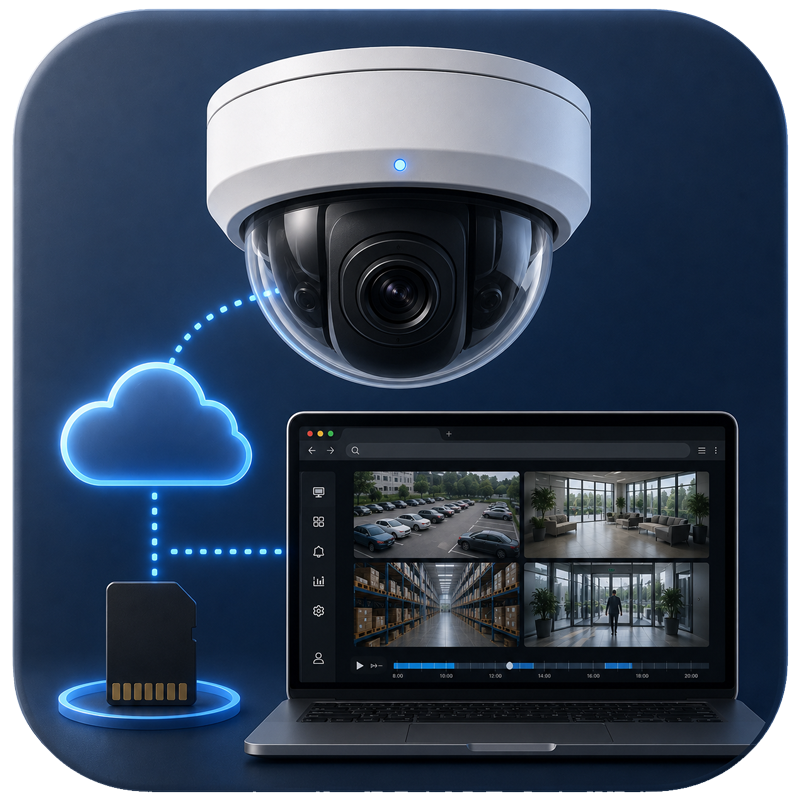
It depends on how your business operates. On-premise NVR keeps all footage local, works without internet, and has no monthly cloud fees, which suits storage-heavy sites and single locations. Cloud video is easier to manage across multiple sites, gives you offsite redundancy if a recorder is stolen or damaged, and lets you scale users without IT involvement. For many businesses, a hybrid setup is the right answer: local recording for full retention, cloud backup for the clips that matter most. We'll recommend the right mix based on your sites and your incident history.
That depends on the storage size, the number of cameras, the resolution, and how busy the scene is. Most commercial systems we install retain 30 to 90 days of footage, which is enough for the vast majority of incident reviews and insurance claims. If your industry requires longer retention (some compliance frameworks call for 6 months or more), we size storage to meet that requirement on day one so you're never caught short.
Yes. Every system we install includes a mobile app for live viewing, clip playback, and incident sharing. You can view single sites or jump between multiple locations from one app, share clips with police or insurance with a tap, and grant or revoke access for managers and employees without calling support. The app works on iOS and Android. For businesses that need active oversight beyond self-monitoring, we also offer AI-powered video monitoring with real-time threat detection.
Yes, if your system includes on-premise storage. Local NVRs keep recording to the hard drive even with no internet connection, so you never lose footage during an outage. Once internet is restored, remote viewing, alerts, and cloud backup resume automatically. For pure cloud systems, recording continues if the camera has a local buffer, but extended outages may create gaps. We design for this based on how reliable your site's internet is.
In most cases, yes. We work with the major access control and alarm platforms used in commercial buildings, including Alarm.com, Avigilon, Verkada, and most ONVIF-compliant systems. Integrating cameras with door events and alarm triggers gives you a much more useful security setup: when an alarm fires or a door is forced, you get the relevant camera clip pulled up automatically. If you tell us what you already have, we can confirm compatibility before any quote.
Not always. If your building already has Cat5e or Cat6 cabling in usable condition, we can often reuse it for new IP cameras. When new cabling is required, our team handles the design, the run, the terminations, and the cleanup, so you're not left with cables draped through the ceiling. Older coax-based systems usually do need new cabling to support modern IP cameras, but in some cases we can use coax-to-IP converters to extend the life of existing runs.
It depends on the number of cameras, the cameras themselves, the storage setup, and how complex the cabling is. A small office with 4 to 6 cameras typically lands in one range, a multi-bay warehouse with 16+ cameras lands in another, and a multi-site retail operation is a different conversation entirely. We don't quote sight-unseen because that's how customers end up with the wrong system. After a free site walk, you get a line-item proposal that shows exactly what each piece costs, so there are no surprises later.
No. We don't lock customers into multi-year contracts as a condition of doing business. You own your hardware. If you choose a cloud video service, those typically come with month-to-month or annual options, and we'll be upfront about which one applies before you sign anything. Our goal is to earn the support relationship by doing the work right, not by burying you in fine print.

Systems Installed
Service Available
Technicians